Showing posts with label vegetables. Show all posts

Wednesday, 16 April 2014

Kid Friendly Kale Chips

If someone had told me a couple of years ago that I would be able to get all three of my daughters to eat kale, no, beg to eat kale, I would have given you the side eye and said you were pulling my leg. My younger two daughters can be quite fussy and it has been hard to find a variety of healthy foods that they are willing to eat.

I have read numerous books and websites about how to encourage fussy eaters to try new foods, and one suggestion that always stood out for me was to grow food with your children. The idea is that if they are involved in the whole process of producing their own food, they will be more willing to eat the food. I have grown a kitchen garden in my backyard for three years now, on top of previously growing in containers. While I would not say that the change has been immediate, I think that the general environment of being around growing food, watching it grow, learning about the insects in the garden, and sampling what we have has overall contributed to my girls willingly trying something new. They enjoy picking spinach, chives and snap peas for a quick snack while they play in the summer.

One of my favourite vegetables to grow is kale. It is a perennial plant that we grow as an annual, so it can survive winter here on the west coast and come back to life quickly. I am growing two different varieties of kale at the moment, and both of them have begun to grow again with the warmer temperatures of early spring.

I love how water beads on the kale leaves.


It has taken a couple of summers of making kale chips, but now all my girls enjoy eating it. In fact, because I wasn't able to harvest a large amount from my garden today and therefore only made a small batch for their snack, they were begging me to go out to the garden to get more kale. They finished the bowl I made for them in less than five minutes.

Just harvested and ready to make into kale chips.


I think what kids like about kale chips, much like popcorn, is the seasoning. Basic salt is of course tasty, but I have begun to mix it up with different seasoned salt. My favourite seasoning is an organic chipotle  garlic salt that we picked up at a summer farmer's market.


Another trick to getting kids to enjoy kale chips it to make sure that each leaf is properly coated in oil. When it is too dry (not enough oil) it can be hard to swallow. When I toss the leaves with oil I gently rub each leaf with my fingers and thumb.

My last piece of advice is to reassure reluctant kids that if they don't like it after trying it they will not have to eat anymore. My middle daughter is easily turned off by food that looks unusual and she did not like the look of the baked kale when she first set her eyes on it. She only had a few bites the first time she tried it, but to her credit (and this is huge) she continued to have a few bites each time we made it, and now she loves it. I never forced her to eat it, and in fact she refused to try it for some time after I started making it. It helped her to hear her other sisters rave about how much they loved it.


Ingredients:


  • fresh, raw kale
  • oil of choice (I use olive oil)
  • salt or seasoning of choice 

* I don't measure the amounts. Experiment and see what works.


Instructions:

  • Preheat the oven to about 400 F. I use stoneware and like to put it in the oven as it is heating to ensure the chips are crispy. When I have not done this the kale remains soggy. If a conventional baking sheet is used this is unnecessary.

  • Thoroughly wash and dry the kale (if the kale is wet the oil does not adhere well, resulting in dry kale chips).
I like to use a salad spinner to dry the leaves, but if
necessary, pat with a dish cloth. 

  • Rip the kale off the thick inner stalk and into pieces slightly larger than bite sized (the kale shrinks when baking).
Left over kale stalks ready for the compost.

  • Toss the kale with oil, as much as is needed to coat all pieces. Be sure to gently rub each piece to completely coat with oil.

  • Sprinkle seasoning and toss.
  • Spread evenly on a baking sheet. Be sure to not layer too thickly or the kale will not crisp properly. If needed, do two batches to ensure the kale crisps. 
  • Check frequently. Once the kale appears slightly browned, it may be necessary to turn the layers. Because I preheat the pan I now do not have to do this.
  • Take the kale chips out of the oven when desired crispness and browning has occurred. Don't overdo it or it will taste burnt. In my oven, with the stoneware, I leave it to cook for approximately 10-15 minutes. 


Tuesday, 18 June 2013

Late Spring Garden

It is late spring and we are getting closer to the longest day of the year. My garden is coming along nicely and we are now able to enjoy the fruits of my labour with delicious, local, organic meals. Last night we had boiled potatoes and salad that included salad lettuce, deer tongue lettuce, quinoa greens, chives, parsley, celery, peas and garlic scapes, all from my garden. So delicious, and even more so because I grew them all myself.

I doubled my garden space this year with two more raised beds and I love how I can grow so many different kinds of vegetables this year, including many new ones to me. 


In my first bed I planted beets that I started from seed inside in early spring down the middle. I am hoping that the beets are finished before the squash (zucchini, saucer squash and pumpkin) take over. Very soon I will be putting tomato cages around the zucchini to help contain them and give more space to everything that I have squished in here. 
Beets down the middle, saucer squash, zucchini
and pumpkin around the outside

I planted garlic last autumn. Originally there were five rows of five to six garlic cloves each, but as can be seen, much of the garlic either did not come up or died shortly after. However, the garlic in the far right of the photo, which is from The Terra Nova Sharing Farm here in my community, has all come up and is thriving. I am starting to think that this is due to landrace gardening, in which the most successful seeds from a prior harvest are the most successful in subsequent gardens because they are best suited to a particular growing area. The bulbs that were not successful were all organic but I do not know where they came from. When most of the garlic failed I had lots of space to plant carrots, kale and onions, which in retrospect is a good thing because I was sad that I wouldn't have room in my other beds for these plants. 
garlic, kale, several kinds of carrots, onions

Here is the Sharing Farm garlic close up. There are still some scapes left that I plan on using by the end of this week.
Garlic - can you see the curly scapes?
I made basil pesto with my scapes (and supplemented with some from a local farm) and my own sweet basil. Amazingly delicious! A little pesto goes a long way, however, so I am going to freeze the leftovers in ice cube trays and use in small amounts as needed.
basil scape pesto
My cucumbers did not do well last year so I am trying growing up with a trellis. So far so good, as I have lots of flowers and even some tiny cukes. I started this bed with a variety of greens to harvest while I wait for the cukes to fill in. On either side of the cukes is mustard greens, and so far this is the winner for my husband and myself. It sautés quickly, which brings out the slight mustard flavour. Behind the cukes are salad lettuce, deer tongue lettuce and arugula. 
Cucumbers, mustard, lettuce, deer's tongue,
arugula, more beets, quinoa
Here is one of the many dinners we've had lately with sautéed mustard greens. This time I did them with garlic scapes and balsamic vinegar.

The quinoa is my other favourite. I need to thin them out, but in the meantime I'm enjoying the young greens. Very tasty. It's fascinating watching them grow as most people are used to seeing the seeds but have never seen what the plant looks like. 
Quinoa in the background, chives, lavender and
my daughter's baby tree in the foreground.
Around my beds I have many plants in containers, including strawberries, more greens, thyme, parsley, celery, lavender and rosemary.
My favourite herb - rosemary.
In my last bed I have peas (snow peas, snap peas), beans (dragon and green beans), chard, Brussels sprouts (which will eventually take over in the fall), and potatoes. The peas are coming in like crazy, which pleases my girls who enjoy picking them for a quick snack when they play outside.
Snow peas and snap peas in behind.
Despite growing too much chard last year and finding out my family isn't especially fond of it, I am growing a few plants again this year. I like having chard for sauces and stews.
Chard 
My potatoes are huge! We harvested our first of the potatoes for dinner last night and my goodness they were so sweet. I hope they last with the way we like potatoes in the summer.
These potatoes are full and tall! 
Of course I had to grow Brussels sprouts again. I like having them freshly harvested for our family Thanksgiving and if there are any left, for Christmas dinner as well. I think cabbage moth caterpillars are eating mine again so I need to deal with them soon. I forgot to cover them with my garden cloth to prevent this so I am going to try sprinkling them with a mixture of baking soda and flour (supposed to kill the caterpillars when they ingest it).
My Brussels sprouts - not looking so good.
Next up I am going to be reseeding several greens to continue my supply through the summer, and transplant my tomato babies into larger pots. I started them quite late this year as we went on a spring break vacation so they are still small and needing lots of TLC. 

I look forward to seeing how this year's garden develops through the growing season!

Wednesday, 12 September 2012

Garden Reflections 2012

The growing season is quickly coming to an end. I can feel the nip in the air in the morning and evening, and we have to remember to take a hoodie or light coat when we head out the door. As much as I will miss summer, I am excited about the changing colours of the leaves, the smell of pumpkin spice and pulling out my favourite sweaters again. We are crazy for Hallowe'en in my family, which is a close second to Yule and Christmas. If I were being honest with myself, I think autumn may be my favourite season.

But I am sad to say good bye to my veggie garden for another year. This was my second summer with full garden beds in a backyard (container gardening in our townhouse in years prior) so I am a newbie and don't think of myself as a gardener yet. But I am starting to get my "sea legs" and figure things out through trial and error.

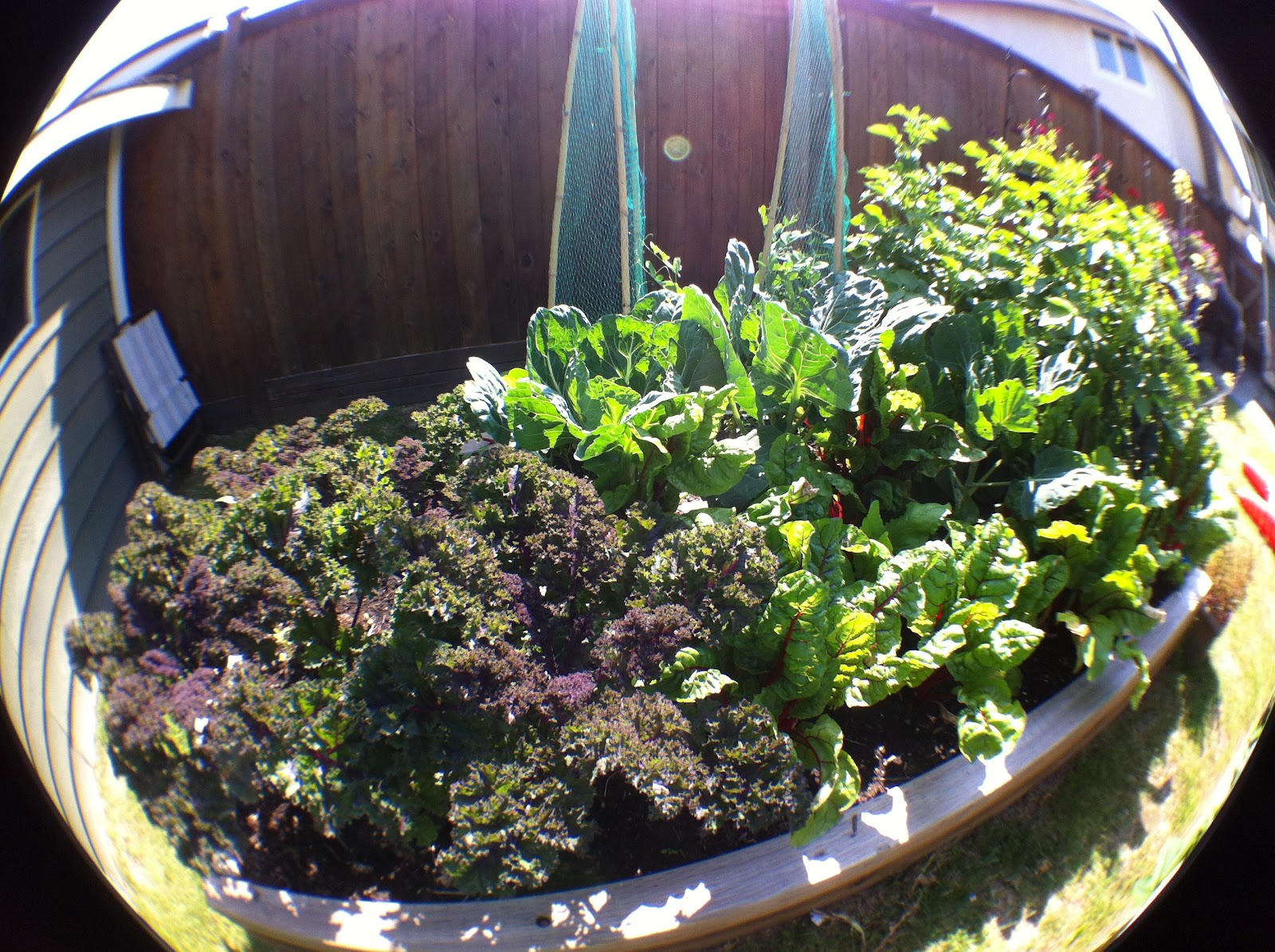
One of the raised beds in mid July.

After following some urban farming blogs I am starting to get the idea that I need to keep a journal of the season to remember what grew well, what didn't do well and why, any problems I encountered and any changes for next year. So that is what I hope to do with this post!

This is what we gave to our neighbours several times throughout the season. 

This year, for the first time, I grew almost everything from seed, and with a few exceptions this went well. I grew the following:
pumpkins
zucchinis
carrots
cucumbers
radishes
tomatoes (two kinds)
swiss chard
brussels sprouts
kale
spinach
lettuce
beets
peas
green beans
potatoes (seed potatoes from last year in soil)
cilantro*
basil*
strawberries*
chives (from previous years)
green onions (from previous years)
raspberries*
blueberries*
*not from seed

Some of the seed packets I used.

One of the things I loved about growing my plants from seed is that it was immensely satisfying watching each and every plant sprout and grow taller and stronger. My daughters and I would check on them daily and talk about what the seeds looked like, perhaps why some sprout sooner than others, and why some didn't sprout at all. We had great conversations about optimal growing conditions, and what happened when a section of seeds and seedlings were overwatered or didn't get enough light. It was an amazing learning opportunity for all of us to see the seedlings, which all looked pretty much the same as initial sprouts, begin to differentiate into the various plants, and we had fun trying to identify them without looking at the labels on the pots.

My wee babies, I mean seedlings.

The other thing I loved about growing from seeds is that this time I really felt like they were my plants. In fact, they were like my children and I felt pride and joy as they grew stronger and began to yield food for us. Conversely, I felt sad when some died because I planted them outside a little too soon and when some struggled after some heavy rain. I felt far more invested in them compared to the plants I have purchased.

In the foreground are the tomato plants, then peas, beans and squash in behind.

Next year, however, I will not grow herbs from seed. I have had difficulties with this in the past but thought I would try again. My basil never fully thrived and it had a very bitter taste throughout the season. Perhaps it didn't get hot enough for it at a crucial point in its growth (we had a chilly, rainy spring).  I don't seem to be able to kill my chives and green onions though. The chives were given to me from a neighbour a couple of years ago and my green onions were started years ago.

Shortly after planting the newbie plants. On the right side you 
can see the peas which should be much taller by this point. 
I planted them too late.

I believe that turning the soil in my garden beds with steer and chicken manure in early April really made the difference for healthy and full plants. Last year our neighbour built the first raised bed for us (we are so lucky) and I'm not sure the soil was the best quality, especially after seeing the difference this year when my neighbour added another raised bed to our yard but I bought the manure to add to both beds. I'm looking forward to using our own compost material next growing season. I wonder if I should still add some manure? Maybe I can get some from a local organic cattle farm?

Our compost bin, purchased from the City of Richmond.

So what will I do differently next year? In addition to not growing herbs from seed (unless anyone can give me some helpful tips), I will plant my peas about a month earlier, and I will plant my pumpkins a month later. I will also put much more thought into planning where to put each plant. I was careful with spacing this year (major problem last year) but really, growing brussels sprouts next door to kale really wasn't bright. My poor cucumbers, which really weren't happy from the get-go (must read more about them) became swallowed by first the zucchinis, then the pumpkins, which were threatening to strangle us in our sleep.


Tomatoes can be finicky here in our temperate west coast climate and once again they were a challenge for me. I usually buy my tomato plants already with tomatoes on them, but last year I had fun watching them develop from small three inch plants, so as mentioned previously, I tried them from seed. One of my tomato varieties was much happier than the other, at least for growing here in Steveston. The yellow grape tomatoes are ripening much more successfully than my larger red tomatoes. The larger tomato variety became stressed in mid August (or at least that's what my internet search results told me it means when the leaves flip over and curl) and I couldn't figure out why. Coincidentally the yellow grape ones are a heritage variety I picked up at the Foxglove Farm and Garden on Salt Spring Island, B.C.


The first harvest of tomatoes that made it into the house. 
We popped them into our mouths as fast as they ripened.

What other challenges did I face? My pumpkin leaves got a powdery mildew in August, which spread to the zucchinis. Other than slightly slowing down their growth and looking really ugly, I didn't notice any ill effects. The pumpkins themselves look great right now (fully ripe) and the zucchinis are still producing for us.

We have eight pumpkins in total this year.

I don't know if I will be able to sweet talk my neighbour into building us another raised bed next year (I'd like two more for my backyard and eventually some in the front yard), but regardless I want to plant more of the veggies my girls enjoyed eating this year: triple the number of peas (a huge favourite), beans and cucumbers; double the carrots, beets, spinach and radishes. I will half the number of zucchinis, chard and kale, mostly because we also participated in a local CSA: community supported agriculture  veggie pick up once a week and guess what they grew?!? Yup, each week we were inundated with zucchini (at one point I had over two dozen in my fridge), chard and kale from both gardens. Green smoothies anyone?!

The first week's veggie pick up from the Terra Nova Sharing Farm

Our garden continues now with the brussels sprouts, which I am looking forward to harvesting at Thanksgiving in October, and possibly for Christmas dinner again. This past Christmas morning I was so proud to cut the last stalk out of my garden and cook it up for my family.

Freshly harvested brussels sprouts on Christmas morning!

At a recent visit to the UBC Botanical Garden I purchased a winter gardening guide book which I am slowly working my way through; however I'm too late to do a winter garden this year. Hopefully next year I'll have plans in place mid to late summer to begin a winter garden. Perhaps it is a good idea to grow kale in the winter garden instead, along with some cabbage (which we missed this year) and other hardy veggies.

I'm sure I'm forgetting some other crucial bits of information I will need but this long enough and a lot to process.

Do you have a backyard garden? Do you container garden? What have you learned this year?