Showing posts with label Better Back To School Brigade. Show all posts

Monday, 26 August 2013

Ten Ways to Green School Supplies


This week I am again participating in David Suzuki's Queen of Green Better Back To School Brigade, to discuss ways to reduce the environmental impact of back to school, which can often be significant with the waste that is produced from shopping, lunches, and commuting. This week's theme is greening school supplies. Click on the badge to the left to visit the Queen of Green's site and read all the other amazing bloggers take on greening back to school.

In the school district where I work and my children go to school, the purchasing of school supplies is done by the individual schools (based upon teachers' preferences from a preapproved list) and families are asked to pay a very small fixed amount for the entire year's supplies. Aside from additional items not covered that a teacher may request, my back to school supplies shopping is covered. Therefore greening school supplies at the point of purchase it out of parents' hands where I live.

As a teacher, and an adult in my children's lives, however, I can have a big impact upon how they use the supplies. Schools use a tremendous amount of paper and there is the potential for great wastage. Below is a list of ways to be more green (be less bad) in the use of school supplies at school and at home. As parents we can encourage our children to be more mindful in their use of school supplies, but it is also good to be aware of what teachers can do to make a difference.


  • Teach children to take good care of and keep track of their belongings, both at home and at school, so that pencils, erasers and other supplies do not go missing. This is just common sense, but I am always surprised by the number of students who do not keep their materials in a pencil box or who do not clean up their desks on a regular basis. I have helped many students clean out their desk because they have misplaced their work, only to find twelve barely used pencils in their desk. Or there are those students who do not clean off the surface of their desk at the end of the day who are surprised that the loose pencil crayons they left all over are now missing.

  • Similarly, teach children to take good care of school materials in general, at home and school, so that things are not carelessly broken, requiring replacement. Kids drill holes in their desks, lean back in their chairs which weaken the legs, and bang on computer mice and keyboards. Yes, I know, easier said than done. I am a parent and I am constantly working on this one.

  • Have a lost and found box for everything that is found on the floor so that new packages of materials are not needlessly opened. When a student says they have no pencil or eraser I direct them to the lost and found box to find one to use. 

  • Building on the idea of a lost and found box, collect all the loose pencil crayons or felts and have in a big tub for students to use when their own materials run out or go missing. At the end of the year I have students go through the tubs to check for worn out felts and ensure that everything in the tub is in working order for the following year. They often don't need a whole new pack of felts when just one or two colours run out.

  • Encourage students to use the whole page in notebooks. They often like to use one side of the paper and leave the back of the page blank because it looks neater, but this is very wasteful. It is easy for organizational purposes to leave the rest of a page blank at the end of an assignment but I teach students to skip a line or two (or even draw a line across the page for visual purposes) then begin the next one. We talk about why we do this and why it is important so that I guarantee more buy in, instead of having to remind them on a weekly basis.

  • Children naturally opt for a blank, clean piece of paper for their work, and it is our job to teach them when they can use scrap paper instead. In many classrooms teachers have scrap paper bins for writing drafts, sketching, math thinking and computations, etc. It is also important to teach students to also put their used paper (still useable on one side, larger scraps) into the scrap bin for others to use rather than throw it into the recycling bin. I add leftover notices, worksheets, etc. into the bin as well.

  • Before grabbing a new notebook, look through existing ones to see if there are empty pages. Toward the end of the school year, look through books for blank pages and spaces that can be used first. For new projects we sometimes flip a notebook upside down and backwards to use the back of the book. All it takes is a creative cover / title page to create a new theme.

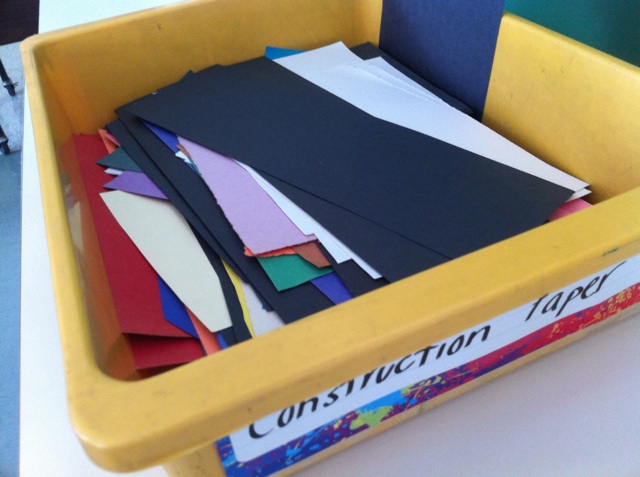
  • When using art supplies, teach children to only take what they estimate needing. For example, they can share a piece of construction paper to cut down on the scrap waste after cutting a whole piece of paper for a small amount. Or they can share a tray of paints amongst several students. 
  • Encourage schools to have the option of electronic newsletters via email or school websites. 

  • Cut down on the amount of photocopying! It is important for parents to know that often there aren't enough textbooks for every student, and for homework it isn't possible to share books. In those cases teachers must photocopy pages. For time management reasons it isn't possible, or realistic, to ask students to handcopy pages of work. As a teacher I am being honest when I say, however, that there is too much photocopying done in schools. There are solutions, such as a Risograph (or Riso printer) that can print on newsprint paper and are cheaper per click than photocopiers. But there are also alternatives to copying work, and I can't help but think about schools throughout the world that survive and thrive without this technology. My job share partner and I have made a pact that this year we will think of instructional alternatives before opting immediately for photocopying, and we will only use scrap paper (ie: used on one side) when we need to copy.

This is by no means an exhaustive list of ways to be more mindful of the use of school supplies, but it is a start. Do you have any additional ideas? I'd love to hear them.

Don't forget to enter the Queen of Green Better Back To Brigade week two giveaway. Enter the contest below for your chance to win!


a Rafflecopter giveaway

Monday, 19 August 2013

Top 10 Back to School Eco Tips


This week I am participating in David Suzuki's Queen of Green Better Back To School Brigade, to discuss ways to reduce the environmental impact of back to school, which can often be significant with the waste that is produced from shopping, lunches, and commuting. Click on the badge to the left to visit the Queen of Green's site and read all the other amazing bloggers take on greening back to school.

As a mother of school aged children and a teacher I am working hard on crossing adventures off my summer bucket list because September is looming, which means I have to start back to school planning for both my children and myself. I won't be running into stores like Walmart because I believe that all those cheap goods come at a cost and are usually not environmentally friendly in their materials, production, and transportation, not to mention the unethical labour practices of the companies. Being green doesn't just mean buying with a conscience, however; it means doing things a different way.

Here are my back to school eco tips:

  • Go through previous years' school supplies. Make a note of what has worn out or broken. Can it be fixed, or is there something around the home that will do instead of buying new?  
    When we get our list of supplies from the teachers we
    will go through what we have here to see if it will work.

  • Before buying new, try upcycling materials from around the home for supplies. With a little bit of work and mode podge, boxes can be personalized and decorated into pencil cases. Or if you have minimal hand sewing skills a pencil roll can be made in an afternoon from fabric scraps. 
    I easily made this for my girls. Additional pockets can be
    added for erasers, rulers and scissors.

  • Before buying new clothes for growing kids, take an inventory of what they have and decide where the gaps in their wardrobe are. Do they have hand-me-downs? Can they buy gently used clothes? My own daughters have been fortunate to receive many hand-me-downs from friends. After going through all their clothes and passing down to younger sisters this month we have only had to buy three pairs of pants and one pair of shoes in total for my three girls. As exciting as shopping for new clothes can be, the tragedy in the clothing factory in Bangladesh has highlighted, even for the general public, the impact of cheap clothing on people and the environment.
    This is all I have had to buy this year for my three growing girls.

  • Walk or ride a bike to school as much as possible. Many schools have a walk to school week, and my daughters' school does Foot Power Wednesday all year. I realize that this can be challenging or impossible for working parents who need to drop their children off on their way to work, but if it is at all possible, it is a great way to get fresh air, vitamin D, and exercise. 
    If you are able to work it into your schedule, grab a coffee or tea
    and walk to school with your kids

  • Make a pledge to pack more local, organic, in-season produce for lunches. It takes more time in the hectic morning routine to pack a lunch with fresh ingredients (rather than grabbing packaged food), and often kids can be fussy eaters, but I believe it is important to eat in season produce to reduce the distance my food must travel. We have a rule in our home that if they don't like what is in their lunch they must bring it home for us to see and we won't be upset.

  • As plastic lunch containers and water bottles break or get lost, replace them with stainless steel options. BPA free plastic is still plastic and has its own risks and problems, which shouldn't surprise anyone. 
    I purchased these at my favourite on line eco shop
    My Little Green Shop. Be sure to put names on the containers
    as these are more expensive than plastic, and if your kids are
    anything like mine, these get misplaced on a regular basis. 

  • If your school does not have food waste composting (which most don't), teach your children to bring home food waste for composting. My oldest daughter had a teacher with a zero waste policy and this meant that any lunch and snack waste was sent home to make parents aware of the impact of their lunch choices. This stuck with us, and now because composting is big in our home my daughters bring home apple cores, banana peels and other food waste. There are some innovative schools that are using composting systems like Bokashi but this is still new, partially because of pest problems. 
    Image source: YardFarm Austin on Flickr

  • Learn about your school's existing green programs. You might be surprised by what your school already has in place and it is important to encourage them and support what they are doing to make a difference.

  • Make eco suggestions to your school, such as the option of e-newsletters to cut back on paper waste. By the end of the month the paper from school that accumulates on my kitchen table is quite remarkable. Or suggest to teachers that they reduce the amount of work that they laminate in plastic, which will take hundreds of years, if not more, to break down in a landfill. Replacing posters can be expensive and we all want to keep treasures and memories from your children's youth, but forever is too long and unnecessary. As mentioned above, perhaps you would like to see a school composting, or even a gardening program. Be warned, however, that you should be prepared to volunteer to make your ideas happen because teachers are already overburdened with large classes and extra curricular activities and are doing the best they can. 


Each week David Suzuki's Queen of Green Better Back To Brigade has a giveaway, and this week it is generously sponsored by Planet Box, Raspberry Kids, Today I Ate A Rainbow, and Abeego. Enter the contest below for your chance to win!


 Raspberry Kids has generously offered a 10% discount to brigaders and their communities. Use the code BetterBackToSchool10 at check out!


a Rafflecopter giveaway