Showing posts with label environmental impact. Show all posts

Friday, 4 April 2014

Coming Out of the Darkness

Lately I have been feeling a bit down about my efforts (and struggles) to live a more eco conscious life. For each change I have tried to make into habit, I see five more behaviours that are questionable, or down right “bad” from a green point of view. Sometimes I feel like a hypocrite, preaching ways to be kinder on the Earth.

Then I read the news and feel even more depressed. In Canada it appears our government is at war with scientists who study global climate change and the environmental impact of development. Oil pipelines might be pushed through without thorough study. Closer to home, my provincial government is trying push through changes to parks and agricultural land to open them up to economic development. Never mind the images in the news of dangerous pollution in Asia from uninhibited industrial growth.

It is easy to get down about making a difference for the environment. Green Bean recently shared her thoughts about keeping hope alive in the face of pessimism. 

I was beginning to think that perhaps it doesn’t really matter if I use a plastic shopping bag on the rare occasion I forget to bring cloth bags, if I drive a minivan, or if I buy something with a huge carbon footprint because, well, I just want it. Reusable energy is too expensive to implement for the average homeowner, and I’m tired of wearing extra layers to keep warm in my own home. I’m tired of worrying about the ingredients in my food, the packaging it comes in, and how and where it was grown. I look around me and I don’t see other worrying about this. It’s all doom and gloom anyway, isn’t it? The climate change deniers are winning, aren’t they?


Continue reading at The Green Phone Booth>>>

Sunday, 30 March 2014

Earth Hour Lessons

We cheated and used battery powered
candles because we don't trust my four
year old around open flames. 
Earth Hour may not have a big impact world wide on reducing the amount of energy consumed, and many criticize it as a useless, largely symbolic act. I like to participate by turning off the lights and not using electrically powered devices and appliances for the hour between 8:30 and 9:30 for the conversations is starts with our children, and I like the personal challenge of finding something we can do that doesn't require electricity. It makes us more appreciative of our modern conveniences, helps us to see how reliant we are upon the electrical grid, and forces us to unplug, however briefly.

We brainstorm what we can do together to pass the time. Often times we play games together, but this year I was not up to it (sad event in the family this weekend). In the end we decided that we would just talk and tell stories together.


As always, challenges like this teach us something, and here is what I learned this year:


  • It is no surprise that we are very dependent upon our electronics for entertainment, especially in the evening. We had a debate about whether it was fair to listen to music or use our smart devices because they are not drawing power from the grid at that moment (even though they are charged from the electrical grid). In the end we opted to go electronic free to be in the spirit of the event. On an unrelated note, we have a solar device charger that we have taken camping with us (to ensure we have a charged camera) that works well, and I have often thought that in an emergency situation this is a good option.

  • I feel like we cheated because I looked around and saw all the appliances we still had plugged in, such as the refrigerator, furnace, hot water heater, television, computers, clock radios, lamps, etc. It is suggested that we unplug all appliances not in immediate use, and this is a goal for us. It is awkward, however, to have to find a lamp cord and plug it into the wall in the dark, and often times convenience win out. 

  • I am surprised how hard it was for us to tell entertaining, original stories to each other. Oral story telling is a dying art and I can vouch for this listening to my girls attempts to tell a story unrelated to a movie, video game or book that they have read. Inspiration comes from a variety of sources and there is nothing wrong with building on someone else's idea, but perhaps we should do more of this. Maybe I should be modeling some stories (which I actually find difficult myself) at bedtime like we used to do when they were little. 

  • It was reaffirmed for me, yet again, how tired I am of hearing about Minecraft because my daughters are a tad obsessed with the game. I am not carte blanche against video games for kids, and I would be a hypocrite to say my kids cannot have any screen time. Everything in moderation. But it feels like it is all they talk about. I want my girls to believe that I listen to them and want to hear what they have to share, even if it isn't interesting to me; listen to them now so that they'll talk to you when they're older kind of idea. But I'm sorry to say that sometimes it sounds like verbal diarrhea.

How did you participate during Earth Hour this year?


Monday, 26 August 2013

Ten Ways to Green School Supplies


This week I am again participating in David Suzuki's Queen of Green Better Back To School Brigade, to discuss ways to reduce the environmental impact of back to school, which can often be significant with the waste that is produced from shopping, lunches, and commuting. This week's theme is greening school supplies. Click on the badge to the left to visit the Queen of Green's site and read all the other amazing bloggers take on greening back to school.

In the school district where I work and my children go to school, the purchasing of school supplies is done by the individual schools (based upon teachers' preferences from a preapproved list) and families are asked to pay a very small fixed amount for the entire year's supplies. Aside from additional items not covered that a teacher may request, my back to school supplies shopping is covered. Therefore greening school supplies at the point of purchase it out of parents' hands where I live.

As a teacher, and an adult in my children's lives, however, I can have a big impact upon how they use the supplies. Schools use a tremendous amount of paper and there is the potential for great wastage. Below is a list of ways to be more green (be less bad) in the use of school supplies at school and at home. As parents we can encourage our children to be more mindful in their use of school supplies, but it is also good to be aware of what teachers can do to make a difference.


  • Teach children to take good care of and keep track of their belongings, both at home and at school, so that pencils, erasers and other supplies do not go missing. This is just common sense, but I am always surprised by the number of students who do not keep their materials in a pencil box or who do not clean up their desks on a regular basis. I have helped many students clean out their desk because they have misplaced their work, only to find twelve barely used pencils in their desk. Or there are those students who do not clean off the surface of their desk at the end of the day who are surprised that the loose pencil crayons they left all over are now missing.

  • Similarly, teach children to take good care of school materials in general, at home and school, so that things are not carelessly broken, requiring replacement. Kids drill holes in their desks, lean back in their chairs which weaken the legs, and bang on computer mice and keyboards. Yes, I know, easier said than done. I am a parent and I am constantly working on this one.

  • Have a lost and found box for everything that is found on the floor so that new packages of materials are not needlessly opened. When a student says they have no pencil or eraser I direct them to the lost and found box to find one to use. 

  • Building on the idea of a lost and found box, collect all the loose pencil crayons or felts and have in a big tub for students to use when their own materials run out or go missing. At the end of the year I have students go through the tubs to check for worn out felts and ensure that everything in the tub is in working order for the following year. They often don't need a whole new pack of felts when just one or two colours run out.

  • Encourage students to use the whole page in notebooks. They often like to use one side of the paper and leave the back of the page blank because it looks neater, but this is very wasteful. It is easy for organizational purposes to leave the rest of a page blank at the end of an assignment but I teach students to skip a line or two (or even draw a line across the page for visual purposes) then begin the next one. We talk about why we do this and why it is important so that I guarantee more buy in, instead of having to remind them on a weekly basis.

  • Children naturally opt for a blank, clean piece of paper for their work, and it is our job to teach them when they can use scrap paper instead. In many classrooms teachers have scrap paper bins for writing drafts, sketching, math thinking and computations, etc. It is also important to teach students to also put their used paper (still useable on one side, larger scraps) into the scrap bin for others to use rather than throw it into the recycling bin. I add leftover notices, worksheets, etc. into the bin as well.

  • Before grabbing a new notebook, look through existing ones to see if there are empty pages. Toward the end of the school year, look through books for blank pages and spaces that can be used first. For new projects we sometimes flip a notebook upside down and backwards to use the back of the book. All it takes is a creative cover / title page to create a new theme.

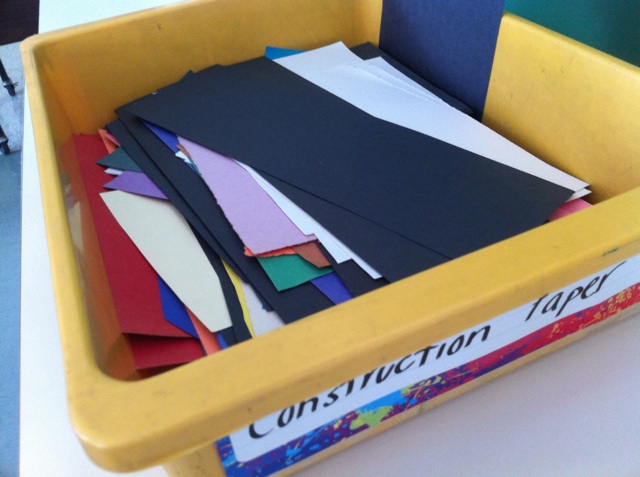
  • When using art supplies, teach children to only take what they estimate needing. For example, they can share a piece of construction paper to cut down on the scrap waste after cutting a whole piece of paper for a small amount. Or they can share a tray of paints amongst several students. 

  • Encourage schools to have the option of electronic newsletters via email or school websites. 

  • Cut down on the amount of photocopying! It is important for parents to know that often there aren't enough textbooks for every student, and for homework it isn't possible to share books. In those cases teachers must photocopy pages. For time management reasons it isn't possible, or realistic, to ask students to handcopy pages of work. As a teacher I am being honest when I say, however, that there is too much photocopying done in schools. There are solutions, such as a Risograph (or Riso printer) that can print on newsprint paper and are cheaper per click than photocopiers. But there are also alternatives to copying work, and I can't help but think about schools throughout the world that survive and thrive without this technology. My job share partner and I have made a pact that this year we will think of instructional alternatives before opting immediately for photocopying, and we will only use scrap paper (ie: used on one side) when we need to copy.

This is by no means an exhaustive list of ways to be more mindful of the use of school supplies, but it is a start. Do you have any additional ideas? I'd love to hear them.

Don't forget to enter the Queen of Green Better Back To Brigade week two giveaway. Enter the contest below for your chance to win!


a Rafflecopter giveaway

Saturday, 30 March 2013

Slow Travel with Kids


 My family recently drove to southern California for spring break. The round trip was about 4 000 km (just shy of 2 500 miles).

We chose to drive for a variety of reasons. First and foremost flying was cost prohibitive for us as a family of five. We looked into flying from the nearest U.S. airport and even though it was less expensive, it would still make our trip beyond what we could afford at this time, if taxes, airport fees, transfer fees and parking were included.

I have a romantic view of family road trips because of all the vacations I spent with my family in a car. We drove to California, the Oregon coast and the west coast of Vancouver Island numerous times, to Barkerville, B.C., the Rockies and completely across Canada to Newfoundland. Even though I know there was lots of fighting, I mostly remember the good. I want my children to know about the places along the way to the destination and I want them to have fond memories of family bonding.

Before having children my husband and I enjoyed driving trips where we could spend hours listening to our favourite CDs (remember those things, before iPods and playlists?). We loved camping and went all over southern B.C. Our longest road trip was driving to San Francisco to visit a friend, and we had a wonderful time.

Both my husband and I were very nervous about driving. I know that driving with children is not novel and people do it all the time. However, five years ago we drove to Calgary with a three year old and a six month old and it was a disaster. To say my oldest did not travel well would be an understatement, and we have avoided long driving trips (more than half a day) ever since. Even the five to six hour drives have been challenging for us.

Once we made the decision I researched the environmental impact of driving versus flying, almost as a way to rationalize our decision to drive. A single vehicle traveling from Philadelphia to Boston would emit 104 kg of carbon dioxide whereas a single person traveling the same distance by airplane would emit 184 kg of carbon dioxide (grist.com). With five of us in a single vehicle (a minivan, so perhaps more than the 104 kg, which is based upon a mid-sized car) emitting approximately 104 kg, we would be having a smaller impact than five of us emitting 920 kg of carbon dioxide (184 X 5).

However, the so-called experts are somewhat divided on which is the more environmental travel method. Some have argued that we should be less concerned about airplane travel, which most of us do very infrequently, than daily commuting by car. I suppose a more environmental way to travel would be to take the train (and would perhaps be more relaxing for the parents) but rail travel is surprisingly expensive and therefore out of our reach.

In the end, regardless of the reasons, I was excited (and still very nervous) about driving from British Columbia to southern California.

The rolling hills of central California

There were some tense moments with my three year old and my six year old got car sick on the way home, but we survived. In fact, given some more time to recuperate, we are excited to plan another car trip because all the benefits of slow travel.


  • It gave my children a sense of geography. We had many conversations about the type of land and plants we saw and we linked it to the climate and elevation. We noted prominent land features and looked up their names.

Mt. Shasta, northern California
  • We shared a map and talked about where we were and how far we were from the next city or how much longer it was until we were in the next state. We asked my oldest to help us look for road signs sharing distances and we talked about the travel times related to distances. I'm not sure how into it my girls were but I hope that over time they will develop more of an interest in map reading, which I believe is an important life skill.


  • My children got to experience places other than our destination when we stopped, albeit briefly.


  • We enjoyed some local produce when we stopped at road side stands. We bought oranges, lemons, almonds, pistachios and peanuts directly from the farmers and they were so delicious.

One of the many orange groves we passed. The fresh, ripe fruit was delicious.

  • It gave us lots of time to talk about what we were anticipating on the way down and reflecting on our favourite parts on the way home.


  • My girls enjoyed skipping at our rest stops. I bought them each a skipping rope (at the suggestion of a friend) to burn some energy and we had fun playing skipping games with them.


Now that we know we can survive multi-day driving trips it opens up so many more opportunities for us. We are beginning to dream about driving to the Oregon Coast, returning to Tofino on the west coast of Vancouver Island, and possibly again driving to southern California but doing the coastal scenic route.

If we had been able to afford air travel we probably would have flown to California this year, given the time it took to drive. In the end though I'm glad we drove and took the slow path.