Showing posts with label Halloween. Show all posts

Tuesday, 30 October 2012

What's in a costume?

Like many families, we start talking about and planning our next Hallowe'en costume shortly after Hallowe'en ends. Of course my daughters change their minds many times throughout the year, and part of the fun is dreaming about all the cool costume ideas we can create. Some of the most used tubs in our playroom are the dress-up tubs. We have accessories for any type of princess you can imagine, pirates, cowhands, gypsies, Indian saris, wedding and bride's maid dresses, carpenters, doctors, wizards, witches, unicorns and on and on. Often my daughters' dress-up games are the beginning of some grand adventure or quest and they can play for hours. That's one of the things that I like about Hallowe'en - the role playing, becoming someone or something else. We can step outside our life and become more dramatic.
My sweet little zombie bride

I have noticed the past couple of Hallowe'ens the "We're a culture, not a costume" campaign, designed to raise awareness about cultural stereotypes. Much has been said about the offensiveness of appropriating First Nations culture by dressing in a feather headdress, and most people I know would not dream of dressing in a traditional Chinese clothing and conical farmer's hat. We can agree that these are racist because they put forth a stereotype of a culture. But what of wearing African tribal clothing? Or wearing fake glasses with "Asian eyes" on them while carrying calculus books? Do people consider it acceptable to wear a turban and say they are a terrorist? Perhaps not in "polite company", school or work, but these types of costumes persist.

This issue came up when I was chatting with my oldest daughter about her costume for this year. She finally settled on being a witch and when I came home with a second hand costume from the local thrift store she was thrilled with the black and green sparkly dress and pointy hat. In trying to decide how to accessorize, she settled upon being a "good" witch rather than an "evil" witch. We began chatting about what made a witch good versus evil. 

Now, before people accuse me of needing to loosen up and grab a sense of humour, I would like to state that I love witch costumes and I love playing up the mythology of a wart covered witch brewing a spell in her cauldron. It is my safety costume and I enjoy putting on the cackling voice and laughter.
Me and my husband

I began telling my daughter about where the myth of the evil witch living alone in the woods came from; persecution of women who revered nature and used knowledge of nature to live. The brewing of spells in a cauldron? Probably came from making herbal tinctures to cure ailments. The Salem witch hunts are well known. Covetous neighbours may have made accusations because they were jealous of their property or something in their life. But largely people were scared of anyone who lived life differently or followed a different belief system so they were labeled evil. If someone was an independent woman who chose not to follow the same path as others she was accused of being a witch and could be burned at the stake or drowned. If she lived the accusations were true. If she died she was cleared of all charges. 
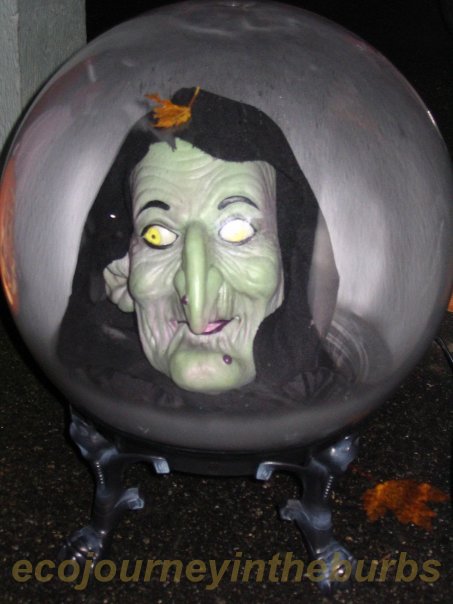
Our speaking witch's head in a crystal ball decoration

This was quite shocking to her. The world to her is still a good place where the worst thing that can happen is someone can get sick and die. She had the same reaction when we read Little House on the Prairie and one of the characters said, "The only good Indian is a dead Indian." Racism (and the word Indian rather than First Nations) was a new concept to her and she had a hard time understanding why someone could be judged, hurt or killed for who they are. 

She asked more questions about witches, and then said, "Maybe we are witches then. We love nature." At first I liked this idea and chuckled. I love that my daughter sees the beauty in nature and is learning to value and protect nature. And I love that she was able to see that witches of yore may have held similar beliefs. But as I thought more about it I became concerned. People do not understand nature based spirituality; too often images of satanists swirl in their heads with the Hollywood version of wiccans. I have heard derogatory comments about people who follow wiccan beliefs. They are seen as weird, and anything odd about them is chalked up to their unconventional beliefs.  

I understand where this comes from. Some people feel that a Muslim woman wearing a traditional hajib is a potential terrorist. We fear what we don't know and we seek to make sense of it. The easiest way is to categorize and stereotype, which brings us back to Hallowe'en costumes. I understand that sometimes the fun of Hallowe'en, for adults, is to shock and push boundaries, and there is a time and a place for that in life. I'm not a killjoy and I love Hallowe'en. I may have worn costumes that offend someone (in fact I'm sure I have) and I will continue to wear witch costumes at Hallowe'en. I will, however, remember that the mythology of evil witches is based upon persecution. 

Happy Hallowe'en everyone!


Thursday, 25 October 2012

An Ethical Hallowe'en

We are Hallowe'en crazy in our family and come October we proudly raise our Hallowe'en freak flag. As fantasy and science fiction fans, my husband and I love to decorate our home in the more macabre aspects of life. At the moment we have light-hearted decorations for our three small daughters. Don't forget the creativity of dressing up in a costume and taking on a role for the day!

There is one aspect of Hallowe'en that has become a concern for me, which ironically is the part that children look forward to the most.

Sure, I am concerned about the harmful effects of sugar and how it has been linked to numerous heath problems. Ideally I want to eliminate it from our diet, and for a number of years I did when I followed a candida diet because of food sensitivities (sugar, caffeine, chocolate, corn). I felt great. However, I am now a mother of three young children living in the suburbs and I don't have time to spend my whole day prepping and cooking meals as I once did, and I am a teacher at an elementary school, so I have become more pragmatic over the years about limiting sugar for kids.

What concerns me right now, however,  is chocolate and how it is grown and harvested. More specifically, I am concerned that children (and I) love eating chocolate in an industry utilizing child slave labour.


Most major candy makers use chocolate farmed using child labour (Nestle, Hershey, Mars). However, these companies in the past have said that they do not support child slave labour and they cannot change this because they do not control the chocolate farmers; they are merely the purchasers of chocolate. This seems like a hollow excuse because smaller chocolate companies can sell chocolate farmed without child slave labour, and as the largest chocolate companies they have the most power to change the supply chain and support ethical chocolate farms. This is also a political problem as often the farming practices are ignored or supported by corrupt regimes. Non-governmental organizations are attempting to make industry-wide changes, but it takes political will and corporate ethics to comply (link).

I love chocolate and when I learned of this I tried to ignore it. I tried to justify buying chocolate, saying that there was no alternative for me. How could I stop eating my beloved chocolate? Rage Against the Minivan puts it well:

People continue to buy chocolate even after learning about these human rights abuses.  I’ve heard excuses from people in my own life that sound pretty similar to the ones I made in the coffee post.  We rationalize that we can’t afford fair-trade.  We joke about how addicted we are.  We justify that we can’t change everything.  And I think secretly, we don’t relate because these are kids in a far-off country, and not our own.  It’s okay as long as we don’t have to see it happening right in front of us.  link

I recently bought a large box of mini chocolate treats for Hallowe'en. Did I feel guilty? You betcha. I should be savouring and truly enjoying my chocolate, rather than unconsciously shovelling poor quality chocolate into my mouth. Thinking this way it is easy to justify spending more on good quality, ethical chocolate. I try to buy ethical, fair trade chocolate for myself (as does my husband, to ensure peace in our home when I've had a difficult day), but for trick-or-treaters? I have yet to contact natural and health conscious stores in Vancouver (Choices, Whole Foods, Capers) to see if they have mini chocolate treats packaged for little Trick-or-Treaters, but the stores in my suburban area do not. The natural food stores do carry ethical chocolate Easter eggs, so must remember that, but I'm not buying Easter eggs for the neighbourhood like I am at Hallowe'en. Perhaps we need to switch to a non-chocolate treat for the little ones. 

If we cut down our consumption of chocolate and treated it as something special then it would not hold the same power over corporations, regimes and corrupt producers. Perhaps we should be consuming it the same way as the ancient Aztecs did, as a sacred ritual, a sacrament.  Honestly, this is wishful thinking because the western world is just as addicted to chocolate as it is to coffee, another industry rife with problems of ethical treatment of farmers and farm workers.

I don't pretend to know what the answer is to this problem but I do know how to vote with my dollar. I must make a stronger commitment to purchasing ethical, fair trade chocolate and stop making excuses for myself. I must also make a commitment to educating people about the use of child slave labour in the chocolate industry, as I am attempting to do here in this post. I must be willing to take the pressure from my children when they ask for unethical chocolate and other treats and explain why I am doing that. 

This leaves me wondering how many other things we consume are produced using unethical practices, be it treatment of workers, farming practices, etc.  Diamonds, coffee, sugar, chocolate - what will it be next? Learning about what we consume is important, but it can make me feel downright depressed and think I should shuck it all and live in a cave.